African traditional leaders meet in Lagos to accelerate action on gender-based violence prevention
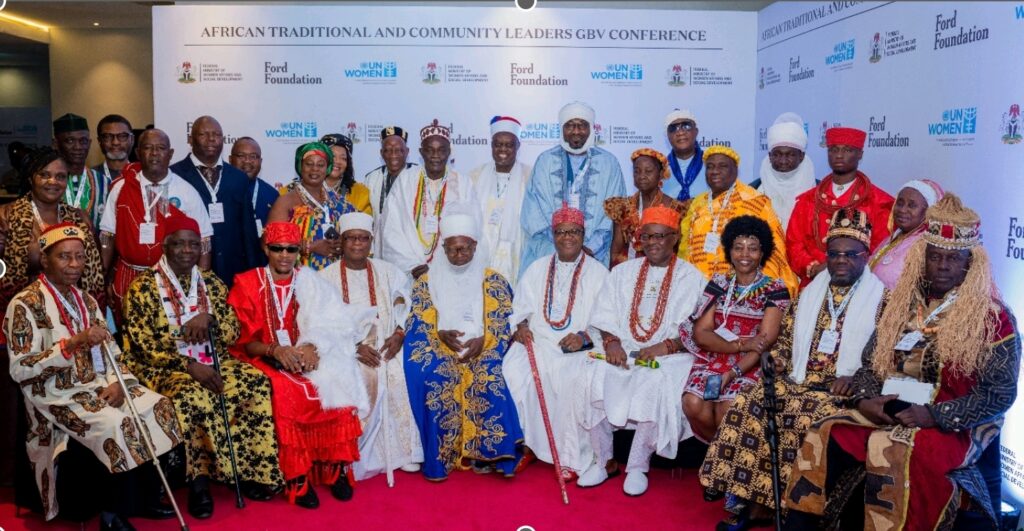
Traditional Leaders at the African Traditional Leaders Conference on Gender-Based Violence. Photo: UN Women/Ford Foundation
Nike Popoola
The Conference of African Traditional and Cultural Leaders on Gender-Based Violence (GBV) Prevention opened today in Lagos with strong commitments from traditional authorities, government representatives, and development partners to accelerate coordinated action to end GBV across the continent.
Convened by the Ford Foundation and UN Women, in collaboration with the Government of Nigeria, the conference drew eminent leaders from across Africa to mobilise cultural authority as a force for protection, justice, and social transformation. The convening underscores growing recognition that sustainable prevention efforts must be rooted in community leadership and the cultural institutions that shape everyday life.
Held at the Radisson Blu Hotel, Ikeja, from 2–3 February 2026, the gathering brings together the Lagos State Governor; His Imperial Majesty the Ooni of Ife; the Emir of Fika; the Emir of Shonga; Chief Siansali of Zimbabwe; President of the Ford Foundation, Heather Gerken; UN Women Regional Director for West and Central Africa, Dr. Maxime Houinato; West Africa Director for Ford Foundation, Dr. Chichi Aniagolu; and UN Women Country Representative to Nigeria and ECOWAS, Beatrice Eyong, alongside senior policymakers, traditional leaders, and civil society partners.
Delivering remarks on behalf of the Governor of Lagos State, Professor Akin Abayomi, Honourable Commissioner for Health, Lagos State, reiterated the urgency of action, stressing that, “Gender-based violence remains one of the most disrupting challenges confronting our society. Silence about GBV is no longer acceptable; change must be intentional. Africa’s future depends on safe laws and just communities that nurture rather than harm”.
Ford Foundation President Heather Gerken highlighted the importance of grounding progress in cultural legitimacy, noting that “The challenges women and girls are facing across Africa — and indeed the world — are real, but so is the immense potential of this region to inspire new ways forward. We are proud to be collaborating with faith and traditional leaders who are working to transform harmful social norms so women and girls in their communities can live to their fullest potentials,” she noted.
From a global policy perspective, Nyaradzai Gumbonzvanda, Deputy Executive Director, UN Women, drew attention to the structural roots of abuse, warning that, “We know what we are calling marriage is actually sexual abuse of girls. Gender-based violence is not the root problem; it is one of the clearest symptoms of the need to affirm the norms and institutions that ensure equality and justice for all,”
Emphasising the central role of culture, UN Women Regional Director for West and Central Africa, Dr. Maxime Houinato, described the convening as a critical turning point, stating that “Across Africa, culture is not marginal — it is foundational. Traditional and cultural leaders are architects of social order. When cultural authority aligns with justice, dignity and equality, communities become safer and institutions gain legitimacy.”
The deliberations reaffirmed that traditional and cultural leaders — by virtue of their moral authority, proximity to communities, and role in customary justice systems — are indispensable to transforming harmful social norms and advancing GBV prevention. Building on years of engagement with traditional institutions and the Council of Traditional Leaders of Africa (COTLA), the conference is formalising cultural leadership as a strategic pillar in national and regional GBV prevention and response frameworks.
Dr. Chichi Aniagolu, Regional Director, Ford Foundation, Office of West Africa, reinforced the point that culture evolves through leadership, emphasising that, “Too often, harmful practices are defended in the name of tradition. Yet culture is not static. It is shaped by those entrusted to guard it. Across Africa, respected chiefs and elders have shown that ending harm does not weaken authority; it strengthens it.”
Speaking from a faith and customary law perspective, HRH Alhaji Dr. Haliru Yahaya Ndanusa, Emir of Shonga, underscored that religion must never be misused to justify harm, saying, “For those hiding under Sharia to justify gender-based violence, Sharia itself says that anything you do that causes more harm than good is not Sharia.”
Mohamed M. Malick Fall, Assistant Secretary-General, Resident and Humanitarian Coordinator in Nigeria, closed the leadership interventions by reminding traditional authorities of the weight of their influence, telling them that, “In the fight against gender-based violence, your influence saves lives. Communities listen to those they trust. When leaders champion dignity, equality and protection, futures are transformed.”
The conference is expected to culminate in the endorsement of a Regional Declaration and Communiqué affirming collective commitments to social norms transformation and the prevention of gender-based violence, alongside a Sustainability Roadmap to embed traditional leadership within long-term national and regional strategies.
Together, these outcomes aim to institutionalise partnerships among traditional councils, governments, African Union bodies, and civil society; strengthen survivor-centred referral pathways at the community level; and catalyse coordinated resource mobilisation to prevent GBV at scale.