Capital projects ongoing, not abandoned – Finance Ministry
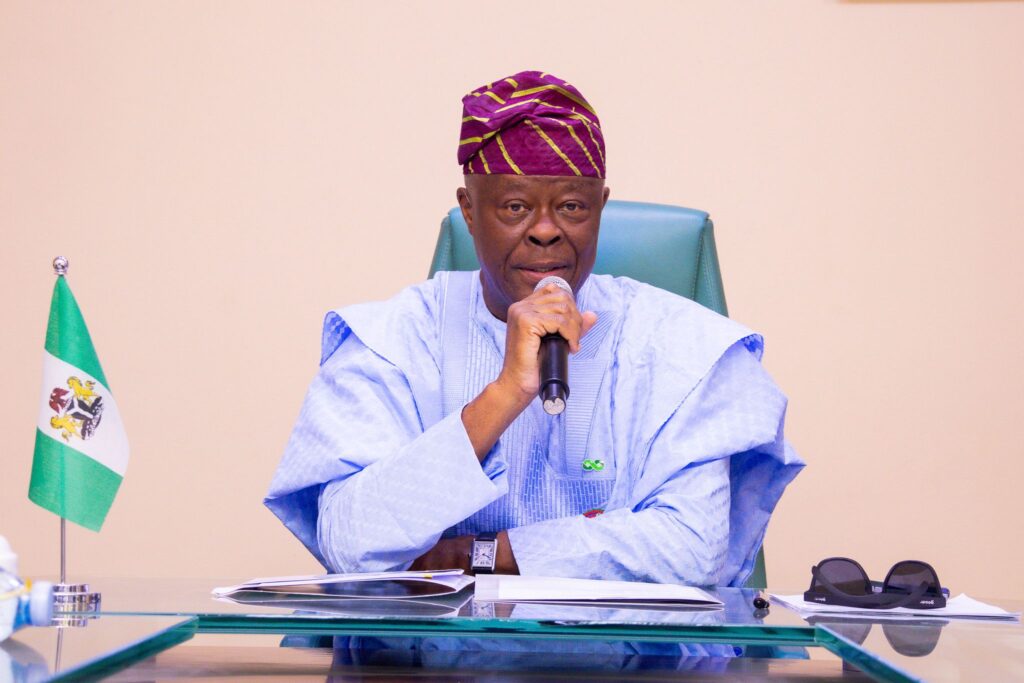
Minister of Finance and Coordinating Minister of the Economy, Mr. Wale Edun,
Nike Popoola
The Federal Ministry of Finance has clarified that capital projects across the country are still being implemented despite concerns over low capital releases to ministries, departments and agencies (MDAs).
In a media brief issued in Abuja, the ministry stated that while budget execution rates for some MDAs may appear low, capital project implementation has not been abandoned. It noted that focusing solely on MDA cash releases provides an incomplete picture of federal capital expenditure.
The clarification was contained in a document titled “Deepening Public Understanding of Nigeria’s Fiscal Position: Context and Background,” signed by the Special Adviser to the Minister of Finance and Coordinating Minister of the Economy on Media and Communications, Dr. Ogho Okiti.
According to the ministry, available data shows that government capital spending remains substantial despite fiscal pressures.
It said total capital expenditure in 2024 reached ₦11.59 trillion, representing about 84 percent performance of the capital budget. Provisional figures for 2025, as of November, show capital spending of approximately ₦11.7 trillion, translating to around 76 percent performance.
“These figures demonstrate that capital projects are ongoing and execution continues. The financing mix differs, but implementation has not been abandoned,” the ministry stated.
The ministry explained that federal capital spending is financed through two main channels: direct funding through MDA budget releases and project-tied financing from multilateral and development partners.
While the first category depends heavily on government revenue and may experience slower disbursements during periods of fiscal strain, the second involves funds released directly by development partners for specific infrastructure or social programmes. Such disbursements may not always appear as cash releases in federal government accounts.
The ministry therefore cautioned that analysing only MDA cash releases can lead to misleading conclusions about the status of capital projects.
The clarification follows recent appearances by the Minister of Finance and Coordinating Minister of the Economy, Mr. Wale Edun, before the Senate and the House of Representatives during deliberations on the proposed 2026 budget.
Lawmakers had raised questions about fiscal performance and the pace of capital expenditure execution.
The ministry attributed the Federal Government’s fiscal pressures largely to significant shortfalls in oil and gas revenue.
According to the brief, projected Federation oil and gas revenue for 2025 stood at ₦37.4 trillion, but actual inflows were about ₦7 trillion, representing a performance rate of roughly 19 percent.
It noted that if projections had been realised, the Federal Government alone would have received about ₦15 trillion more in revenue.
Because oil revenue is shared in a manner that favours the Federal Government more than other revenue sources, such shortfalls disproportionately affect federal finances.
Under the current revenue sharing framework, the Federal Government receives between 53 percent and 65 percent of oil and gas revenues, depending on the specific components, while only 20 percent of Value Added Tax (VAT) accrues to the Federal Government, with the remaining 80 percent shared by states and local governments.
As a result, the ministry said oil revenue underperformance can significantly weaken federal revenue even when overall Federation receipts appear relatively stable.
The ministry also addressed concerns over rising debt service obligations, stressing that recent increases are largely the result of macroeconomic developments rather than fiscal mismanagement.
Debt service payments in 2024 rose to ₦12.63 trillion, exceeding the budgeted ₦8.56 trillion by about ₦4 trillion. In 2025, debt service stood at ₦14.57 trillion compared with a budget projection of ₦13.12 trillion.
Officials attributed the increase mainly to exchange rate depreciation and higher domestic interest rates.
Because part of Nigeria’s external debt is denominated in foreign currencies, the depreciation of the naira automatically increases the local currency cost of servicing such obligations. In addition, tighter monetary policy and higher interest rates aimed at stabilising inflation have raised the cost of servicing domestic debt.
Despite these pressures, the ministry said the government has continued to prioritise debt servicing, payment of salaries and pensions, and capital investment while avoiding monetary financing.
“This reflects fiscal discipline under strain rather than fiscal collapse,” the ministry said.
The ministry further noted that part of the increase in Nigeria’s public debt reflects accounting adjustments rather than new borrowing.
It explained that about ₦30 trillion in Ways and Means advances previously obtained from the Central Bank of Nigeria (CBN) were formally recognised and incorporated into the public debt profile.
In addition, exchange rate adjustments have significantly increased the naira value of external debt. The ministry estimated that roughly ₦70 trillion of the nominal increase in public debt is attributable to exchange rate valuation effects.
According to the ministry, the current administration inherited a fiscal system weakened by structural distortions and hidden deficits.
Since 2023, the government said it has introduced several reforms aimed at strengthening fiscal transparency and sustainability. These include the removal of fuel subsidies, exchange rate liberalisation, the end of routine reliance on CBN Ways and Means financing, tighter monetary policy and improved debt transparency.
The ministry acknowledged that the transition has created temporary pressures but maintained that the reforms are necessary for long-term stability.
It also highlighted improvements in revenue mobilisation. Federal Government aggregate revenue increased from ₦12.48 trillion in 2023 to ₦20.98 trillion in 2024, while revenue had already reached about ₦22 trillion as of November 2025.
The ministry attributed the growth to stronger tax administration, improved remittance compliance by government agencies and stronger non-oil revenue performance.
It added that the 2024 capital budget was largely implemented in 2025, while part of the 2025 capital spending plan has been shifted to 2026 as part of ongoing fiscal adjustments.
“The administration has chosen long-term sustainability over short-term illusion,” the ministry stated.
It emphasised that misunderstandings about Nigeria’s fiscal position often arise from confusing Federation revenue with Federal Government revenue, focusing only on MDA capital releases and misinterpreting exchange rate effects on public debt.
“The evidence shows revenue is rising, capital projects are ongoing, debt growth is largely accounting and exchange-rate driven, and monetary financing has ended,” the ministry said.
“Nigeria is not experiencing fiscal collapse. It is undergoing fiscal correction.”