

Nigeria leads charge for Africa’s health sovereignty
Abdullateef Fowewe
Vice President Kashim Shettima has urged African nations to prioritise health security sovereignty, shifting from foreign aid dependency to robust, self-reliant systems.
This was revealed in a statement on Saturday by Stanley Nkwocha, Senior Special Assistant to The President on Media & Communications (Office of The Vice President).
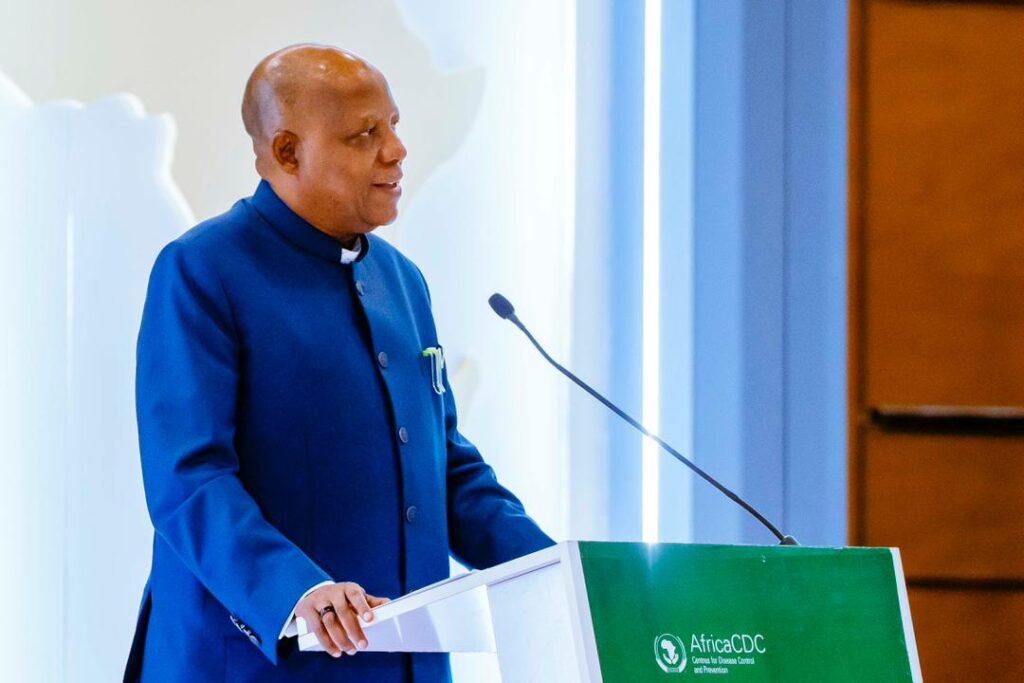
Speaking at a high-level side event on “Building Africa’s Health Security Sovereignty” during the 39th Ordinary Session of the African Union (AU) Assembly in Addis Ababa, Shettima, representing President Bola Tinubu, emphasised the urgency of homegrown health solutions.
“Health security is national security, and in an interconnected continent, national security is continental security. A virus, as we have witnessed, does not carry a passport,” he stated.
The initiative, a partnership between Nigeria and the Africa Centres for Disease Control and Prevention (Africa CDC), focuses on workforce investment, community health, and sustainable immunization.
Shettima reaffirmed Nigeria’s commitment, “Nigeria stands ready to collaborate with every member state of our Union to make health security sovereignty measurable in factories commissioned, laboratories accredited, health workers trained, counterfeit markets dismantled, and insurance coverage expanded.”
Recalling COVID-19 vulnerabilities, he warned against prolonged reliance on external supplies.
“Endurance is not a strategy leadership is measured not by how long vulnerability can be withstood, but by how deliberately we reduce it,” Shettima said.
Shettima highlighted the Nigeria Health Sector Renewal Investment Initiative, launched in December 2023, which secured over $2.2 billion to renovate 17,000 primary health centers, train 120,000 health workers, and expand insurance via the National Health Insurance Authority.
Other efforts include boosting pharmaceutical manufacturing through the Presidential Initiative to Unlock the Healthcare Value Chain (PIPUHVAC), enhancing NAFDAC oversight against falsified drugs, and strengthening epidemic response via the Nigeria CDC.
“We prioritise this because we believe that sovereignty must rest on financial protection as much as on infrastructure,” he noted.
Coordinating Minister of Health Professor Muhammad Ali Pate praised partnerships with Africa CDC and AU, committing Nigeria to lead workforce capacity-building and bridge rural-urban health gaps.
Africa CDC Director General Dr Jean Kaseya commended Nigeria’s reforms amid workforce shortages, urging unified investments.
Health ministers from Senegal (Dr. Ibrahim Sy), Malawi (Madalisto Baloyi), and Ethiopia (Dr. Mekdes Daba) pledged support for workforce databases and community systems.
A communique, presented by Pate, urged AU leaders to accelerate toward 2 million community health workers by 2030, boost domestic financing, and develop national acceleration plans for primary health care and pandemic preparedness.
Shettima closed with optimism: “When history reflects on this generation of African leadership, may it record that, we built a continent that could heal itself.”