

Nigeria poised for more robust phase of economic growth in 2026 – Tinubu
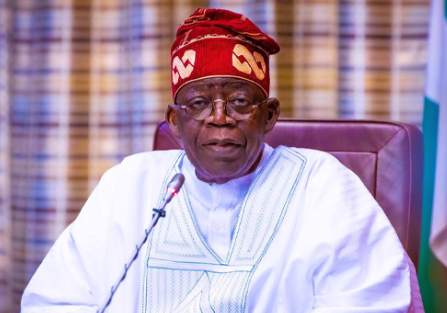
President Bola Tinubu
Abdullateef Fowewe
President Bola Tinubu has declared 2026 “the beginning of a more robust phase of economic growth,” assuring Nigerians that the difficult reforms of the past year are now yielding “tangible and measurable gains” across key sectors of the economy.
In a New Year message he signed on Thursday, January 1, 2026, the President welcomed citizens “with gratitude to God and confidence in our collective resolve that this new year will be a more prosperous one for our nation, our citizens, and all who call Nigeria home.”
Reviewing economic performance, Tinubu said Nigeria “closed 2025 on a strong note,” stating that despite anti‑inflation policies, the country “recorded a robust GDP growth each quarter, with annualised growth expected to exceed 4 per cent for the year.”
He added that the economy maintained trade surpluses, enjoyed “greater exchange rate stability,” while inflation “declined steadily and reached below 15 per cent, in line with our target.”
In 2026, he pledged, “we are determined to reduce inflation further and ensure that the benefits of reform reach every Nigerian household.”
Tinubu also highlighted a bullish equities market, noting that “the Nigerian Stock Exchange outperformed its peers, posting a robust 48.12 per cent gain and consolidating its bullish run that began in the second half of 2023.”
On external buffers, the President disclosed that foreign reserves stood at “45.4 billion dollars as of December 29, 2025, providing a substantial buffer against external shocks for the Naira,” with expectations that “this position will strengthen further in the new year.”
Foreign direct investment is “responding positively,” he said, pointing out that FDI rose to “720 million dollars, up from 90 million dollars in the preceding quarter,” a development he linked to “renewed investor confidence in Nigeria’s economic direction, which global credit rating agencies, including Moody’s, Fitch, and Standard & Poor’s, have consistently affirmed and applauded.”
Tinubu thereby reiterated that his administration had undertaken “a fiscal reset” and “critical reforms that are laying a solid foundation for long-term stability and prosperity.”
“With patience, fiscal discipline, and unity of purpose, Nigeria will emerge in 2026 stronger and better positioned for sustained growth,” he said, following the presentation of the 2026 Appropriation Bill to the National Assembly.
The President vowed to tackle “the challenge of multiple taxation across all tiers of government,” commending states that have “aligned with the national tax harmonisation agenda by adopting harmonised tax laws to reduce the excessive burden of taxes, levies, and fees on our people and on basic consumption.”
According to him, “the new year marks a critical phase in implementing our tax reforms, designed to build a fair, competitive, and robust fiscal foundation for Nigeria,” with the goal to “raise revenue sustainably, address fiscal distortions and strengthen our capacity to finance infrastructure and social investments that will deliver shared prosperity.”
However, Tinubu acknowledged that “economic progress must be accompanied by security and peace,” warning that “our nation continues to confront security threats from criminal and terrorist elements determined to disrupt our way of life.”
He revealed that, “in collaboration with international partners, including the United States, decisive actions were taken against terrorist targets in parts of the Northwest on December 24,” adding that the Armed Forces “have since sustained operations against terror networks and criminal strongholds across the Northwest and Northeast.”
“In 2026, our security and intelligence agencies will deepen cooperation with regional and global partners to eliminate all threats to national security,” he assured, reaffirming commitment “to protecting lives, property, and the territorial integrity of our country.”
Tinubu restated his long‑held position that “a decentralised policing system with appropriate safeguards, complemented by properly regulated forest guards, all anchored on accountability, is critical to effectively addressing terrorism, banditry, and related security challenges.”
The President framed 2026 as a turning point where reforms translate into “tangible improvements in the lives of our people.”
He announced that government will “accelerate the implementation of the Renewed Hope Ward Development Programme, aiming to bring at least 10 million Nigerians into productive economic activity by empowering at least 1,000 people in each of the 8,809 wards across the country.”
Through “agriculture, trade, food processing, and mining,” Tinubu said the administration would “stimulate local economies and expand grassroots opportunities,” while continuing to invest in modernising infrastructure – “roads, power, ports, railways, airports, pipelines, healthcare, education, and agriculture” – to strengthen food security and “improve quality of life.”
“All ongoing projects will continue without interruption,” he stressed.
Tinubu further underscored that “nation-building is a shared responsibility,” enjoining citizens to “stand together in unity and purpose, uphold patriotism, and serve our country with honour and integrity in our respective roles.”
“Let us resolve to be better citizens, better neighbours, and better stewards of our nation,” he appealed, framing 2026 as a collective project that demands sacrifice and cooperation.
Wishing Nigerians “a peaceful, productive, and prosperous New Year,” the President prayed, “May God continue to bless and protect our beloved country, keep our troops safe and destroy the enemies bent on disrupting our national peace, security and stability.”