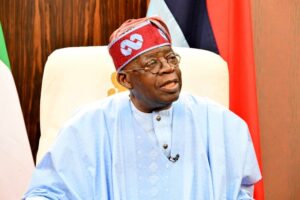

National security key to Nigeria’s economic prosperity — Tinubu

President Bola Tinubu
Abdullateef Fowewe
President Bola Tinubu has said national security remains the foundation for Nigeria’s economic ambitions, insisting that lasting prosperity can only be achieved when lives, communities and businesses are protected.
Tinubu stated this on Friday in Abuja at the graduation ceremony of National Defence College Course 34 participants. He was represented at the event by Vice President Kashim Shettima.
The President said his administration’s economic agenda—which focuses on macroeconomic stability, industrial growth and foreign investment—rests on a commitment to safety and security.
“Our economic ambitions accompany the duty to secure our people,” Tinubu said.
He noted that the Armed Forces and other security agencies remained at the forefront of efforts to tackle terrorism, banditry, kidnapping, piracy and organised crime across the country.
“The Armed Forces and security agencies continue to confront terrorism, banditry, kidnapping, piracy and organised criminality with courage and professionalism,” he said.
Tinubu assured the security agencies of continued government support through equipment, training, resources and institutional backing to enable them to carry out their constitutional responsibilities effectively.
“Government will provide equipment, training, resources and institutional support for their constitutional duties,” he added.
The President stressed that restoring peace in troubled communities must be followed by economic opportunities for residents, arguing that security and enterprise reinforce one another.
“Peace creates room for enterprise, and enterprise enlarges the citizen’s stake in peace,” he said, adding that “when communities recover security, opportunity must follow, because stability grows where people can work, trade, learn and hope.”
Tinubu also aligned with the position of former President Goodluck Jonathan, who delivered a recent graduation lecture at the college, that Africa’s security would increasingly be shaped by productive economies, innovation, regional value chains and industries capable of employing the continent’s growing youth population.
He said the African Continental Free Trade Area offered Africa an opportunity to advance inclusive industrialisation, reduce economic vulnerabilities and strengthen the continent’s bargaining power globally.
According to him, Nigeria remains committed to “a peaceful, prosperous, integrated Africa.”
Tinubu further highlighted reforms under his Renewed Hope Agenda aimed at building a diversified and competitive economy through improved conditions for businesses, private-sector investment, local value addition and infrastructure expansion.
“We are improving conditions for enterprise, encouraging private investment, promoting local value addition and expanding roads, railways, ports, energy and digital connectivity.
“These investments reduce costs, connect markets and reinforce national integration,” he said.
The President said his administration was also developing capacity in agriculture, solid minerals, manufacturing, technology and the defence industry, stressing that national sovereignty depended on the ability of a country to meet essential needs, withstand shocks and defend its interests.
“Sovereignty acquires substance when a nation can absorb shocks, meet essential needs and defend its interests,” he said.
Addressing the graduands, Tinubu said the National Defence College programme reflected the broad demands of modern governance and strategic leadership, with participants drawn from the military, police, public institutions and friendly nations.
He urged them to use the relationships built during the course to deepen cooperation, peace, understanding and development across Africa and beyond.
Earlier, the Commandant of the National Defence College, Rear Admiral Abdullahi Ahmed, said the President’s representation at the event demonstrated the administration’s commitment to strategic leadership development and national security.
Ahmed said the participants underwent 47 weeks of intensive training, including research, field tours and seminar presentations focused on contemporary security, development and high-level defence management issues.
A total of 103 participants graduated from Course 34, comprising 33 personnel from the Nigerian Army, 20 from the Nigerian Navy, nine from the Nigerian Air Force, four from the Police, 17 from Ministries, Departments and Agencies, and 20 international participants.
Awards were also presented to outstanding participants.