
We’re rewriting Nigeria’s story of economic underperformance — FG
Abdullateef Fowewe
President Bola Tinubu has said his administration is rewriting Nigeria’s decades-long story of economic underperformance through reforms aimed at dismantling structural barriers, unlocking the country’s potential and delivering jobs, productivity and shared prosperity.
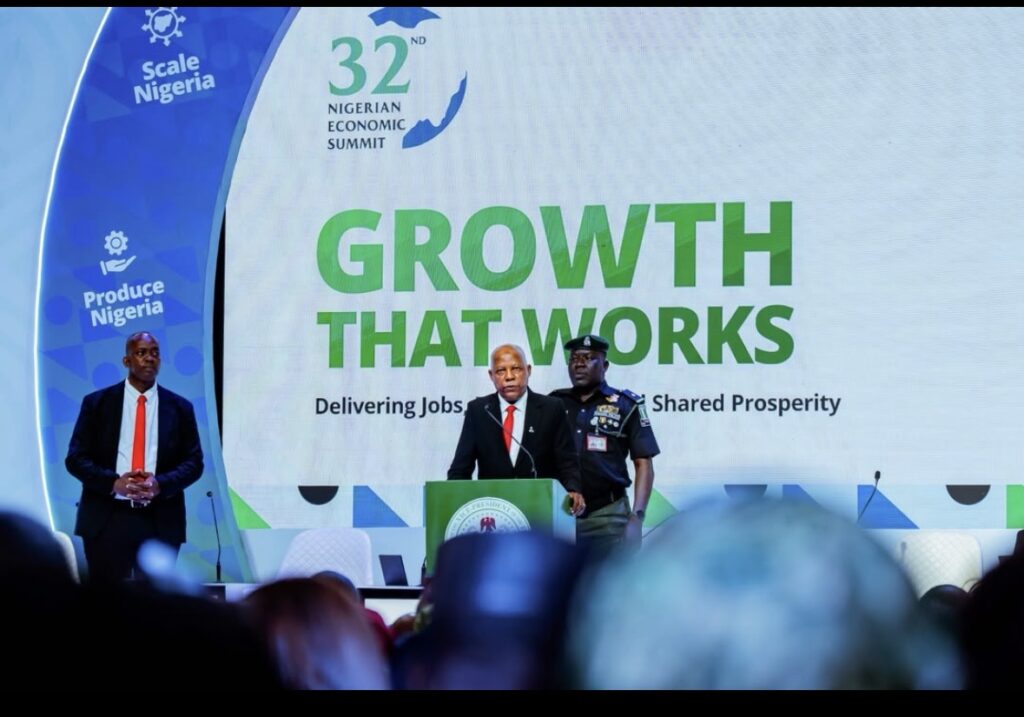
The President, represented by Vice President Kashim Shettima, spoke on Monday in Abuja while declaring open the 32nd Nigerian Economic Summit organised by the Nigerian Economic Summit Group (NESG).
“We came to rewrite the story of a nation that has performed below its potential for far too long. But there is no shortcut to economic growth. This is why we began with a difficult reset,” Tinubu said.
He said the reforms were designed to rescue livelihoods and improve the fortunes of “young jobseekers, farmers, manufacturers, entrepreneurs and innovators.”
“For us, rescuing the economy means rescuing livelihoods and transforming the fortunes of young jobseekers, farmers, manufacturers, entrepreneurs and innovators,” he added.
Tinubu said the administration had set in motion reforms to remove barriers preventing Nigeria’s “abundant human and natural resources from yielding prosperity,” noting that they were “restoring confidence, strengthening our economic foundations and laying the groundwork for sustainable growth.”
Citing National Bureau of Statistics figures, the President said Nigeria’s inflation-adjusted GDP grew by 3.89 per cent in the first quarter of 2026, compared with 3.13 per cent in the same period of 2025.
He added that non-oil activities accounted for 96.08 per cent of GDP, while manufacturing grew by 3.29 per cent and the oil sector by 2.57 per cent.
Tinubu also disclosed that capital importation reached $10.37 billion in the first quarter of 2026, an 83.83 per cent increase over the corresponding period in 2025.
“We will, therefore, continue to ease regulatory burdens, strengthen transparency and policy predictability, and expand access to finance,” he said.
He said the government was reforming the electricity market to improve supply and attract investment in generation, transmission, distribution and alternative energy, while connecting farms to storage facilities, processing centres and markets.
However, the President said the task was not yet finished, stressing that prosperity required greater productivity from “every worker, enterprise and investment.”
“We must judge infrastructure by the economic activity it generates and education by the skills and productivity it delivers,” he said.
Also speaking, the United Nations Deputy Secretary-General, Dr Amina Mohammed, acknowledged the gains of the reforms but urged the government to consolidate and stabilise them, while managing citizens’ expectations effectively.
The Minister of Finance and Coordinating Minister of the Economy, Dr Taiwo Oyedele, presented the Nigerian Economic Policy Framework, describing it as a national economic doctrine that would guide decision-making and measure real progress.
He invited NESG members and private-sector experts to critique the draft “with facts and figures.”
NESG Chairman, Olaniyi Yusuf, said the summit’s task was to ensure the stabilisation of the reforms rather than their reversal, adding that deliberations would focus on job creation, productivity and shared prosperity.
Chairman and Founder of BUA Group, Abdul Samad Rabiu, commended the reforms, saying improved access to foreign exchange had created a more predictable environment for businesses.
“For many years, one of the greatest challenges facing businesses was access to foreign exchange. You could have all the naira but be unable to obtain the foreign exchange needed to buy raw materials and machinery,” Rabiu said.