

Governors declare nutrition emergency, commit to intervention fund after Ethiopia exchange
Abdullateef Fowewe
Governors of Nigeria’s 36 states have resolved to declare a nationwide nutrition emergency and establish a National Nutrition Intervention Fund to accelerate the Nutrition 774 Initiative across all 774 local government areas.
This was made known in a statement made available on Saturday by Stanley Nkwocha
Senior Special Assistant to The President on Media & Communications
(Office of The Vice President).
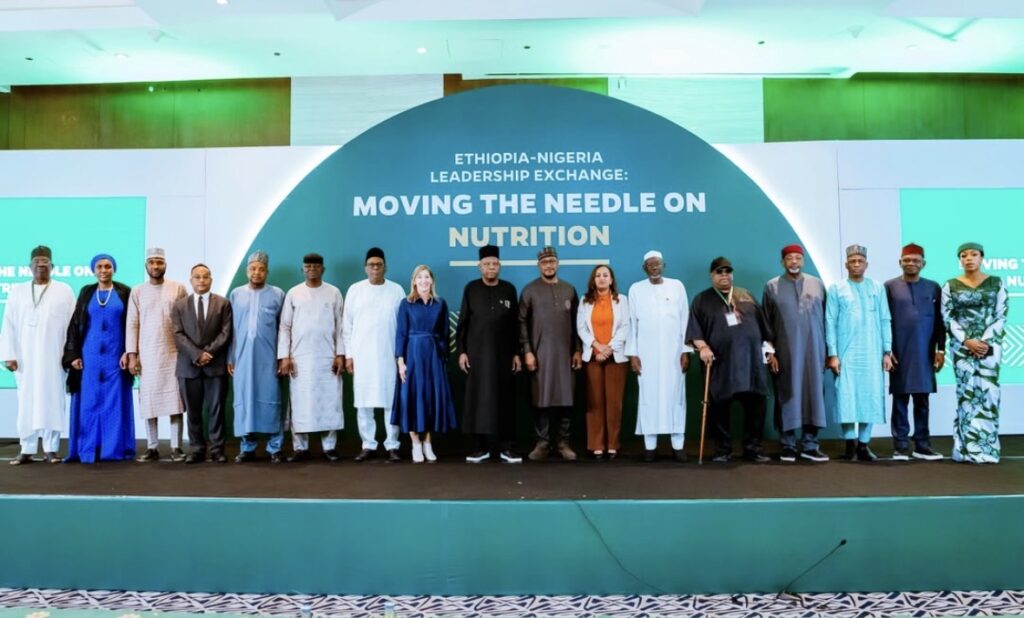
The commitment was announced on Friday in Addis Ababa, Ethiopia, by Zamfara State Governor Dauda Lawal, who presented the Nigeria Governors’ Forum (NGF) Addis Ababa Commitment on Nutrition.
The move followed a three-day Nigeria-Ethiopia Nutrition Leadership Exchange led by Vice President Kashim Shettima.
“We are encouraged that Nigeria’s N774 Initiative already embodies many of the principles we have seen here in Ethiopia.
This leadership exchange has, however, provided important practical lessons on how these principles can be further strengthened and translated into results,” Lawal stated while reading the commitment.
Under the pledges, the governors agreed to declare nutrition a national emergency, create the intervention fund to catalyse implementation, and institutionalise a unified “One Goal, One Plan and One Budget” framework for nutrition.
They also committed to stronger domestic financing, bottom-up planning that reflects community and ward-level needs, and extending the National Nutrition Scorecard to local government and ward levels for greater accountability.
The Federal Government will begin targeted nutrition interventions in two states with a high burden of stunting before expanding the programme.
Dr Muyi Aina, Executive Director of the National Primary Health Care Development Agency, said the approach would involve clear objectives, multisectoral plans, joint financing, and rigorous tracking, with progress reviews involving the Vice President.
The Nutrition 774 Initiative is Nigeria’s flagship programme to tackle malnutrition by delivering coordinated interventions in health, agriculture, education, water, sanitation and social protection down to every local government, ward, community and household.
It builds on a Nutrition Compact signed in February 2025 by the federal government, the NGF (representing the 36 states) and the Association of Local Governments of Nigeria.
Nigeria continues to face high rates of child stunting and malnutrition.
The National Policy on Food and Nutrition 2026–2035 sets targets to reduce stunting to 32 per cent by 2029, 28 per cent by 2032 and 25 per cent by 2035. Earlier in 2026 the initiative’s strategic board adopted a domestic financing model aimed at closing an estimated ₦500 billion funding gap, reducing reliance on donors, and activating instruments such as the Presidential Nutrition Intervention Fund.